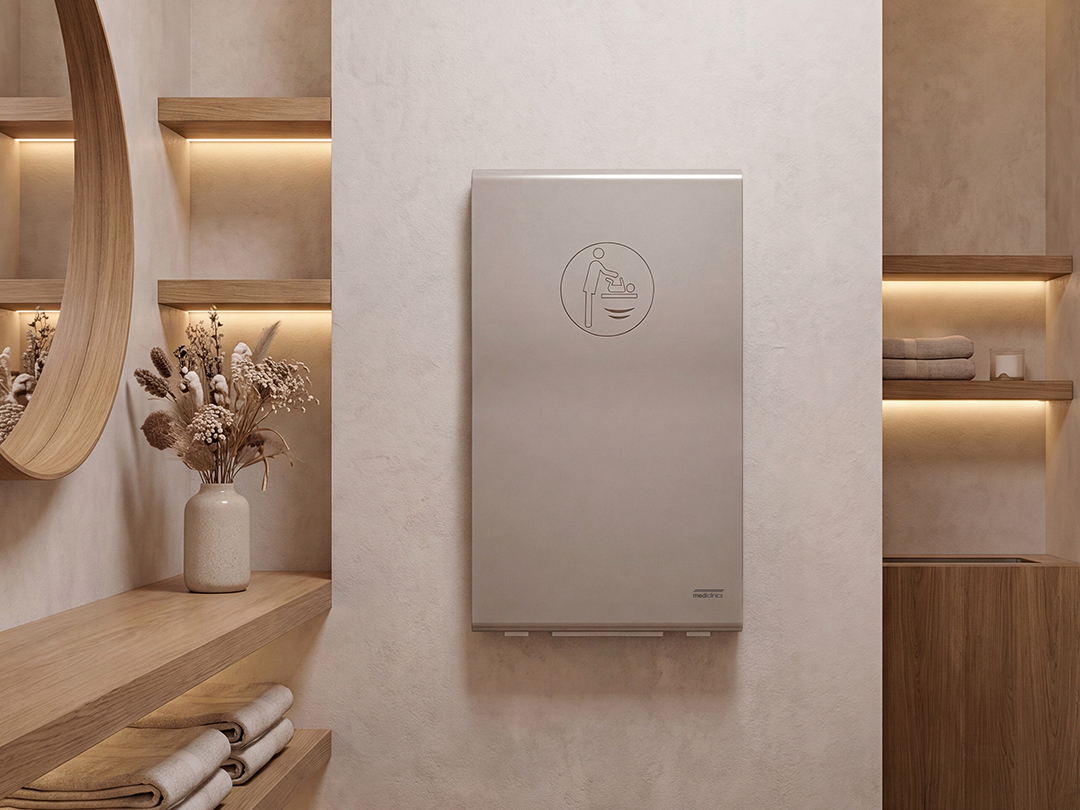
Choosing the right baby changing station for a public washroom project involves much more than meeting basic functional requirements. Architects, interior designers, specifiers and facility managers know that a good baby changing station must meet three essential criteria: a design that complements the space, the highest standards of hygiene and certified quality that guarantees the baby’s safety.
In high-traffic environments such as airports, railway stations, hotels, restaurants, hospitals and shopping centres, the changing station must meet all three requirements at once. Here are the key criteria to consider.
Design and integration: visual consistency and functionality
A baby changing station is not an isolated element. It should blend seamlessly with the overall design of the project and adapt to the layout of each space. There are three key aspects worth considering::
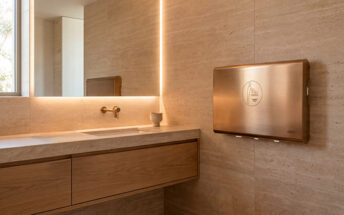
- Design and finishes: In a public restroom, a changing station with softer, rounded lines and a high-quality finish can enhance the overall look of the space. In this respect, AISI 304 stainless steel in a satin or black finish, or PVD coatings in gold, copper, bronze or anthracite, can add an extra touch of sophistication and quality to your restroom projects. Both AISI 304 stainless steel and PVD coatings offer excellent resistance to wear, corrosion and fading, which is essential in high-traffic environments, from contract projects to hospitality settings..
- Format: When folded, the horizontal model has a more compact height, making it an ideal choice for offices, small retail premises, restaurants and clinics. The vertical model, on the other hand, makes better use of the available width and is often preferred in high-traffic restrooms, such as those in airports, railway stations and shopping centres, where every centimetre counts..
- Installation: In addition to wall-mounted installation, recessed installation kits are available, allowing the baby changing station to be fitted into the wall. This is particularly appreciated by architects and interior designers looking to create open, minimalist spaces without unnecessary obstacles or visual clutter.
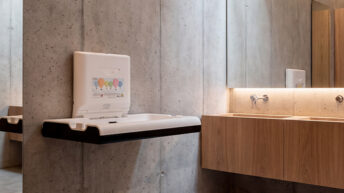
Babymedi baby changing stations stand out for their design, featuring curved, rounded lines and a more refined, carefully considered finish. This is reflected in the three prestigious international awards they have received for design and innovation: the European Product Design Award 2025, the iF Design Award 2026 and the Red Dot Award 2026.
The changing station is available in white polypropylene or AISI 304 stainless steel, in satin or black finishes, with optional PVD coating. It comes in horizontal and vertical formats, and can also be installed using the recessed installation kit for a flush, integrated finish.
Hygiene: the number-one priority
In busy environments such as public restrooms, microorganisms can quickly accumulate on different surfaces. That is why it is important to choose solutions that provide a high level of hygiene and help protect the health of babies and their parents.
BioCote® and Ion Hygienic® are two different but equally important technologies that work together to help achieve this.:
BioCote®
- An antimicrobial silver-ion additive incorporated into the material during the manufacturing process.
- Works continuously, does not wear off through use or washing, and helps reduce the growth of bacteria and mould.
- Complements routine cleaning but does not replace it.
Ion Hygienic®.
- An ioniser that is activated when the changing station is closed.
- Generates negative ions that inactivate viruses, bacteria and mould.
- A sensor detects when the changing station is closed and activates the cycle, which stops if the unit is opened again.
- Battery-powered, with no electrical risk to the baby.
Babymedi incorporates BioCote® throughout the entire range, with Ion Hygienic® available as an option on all models. The combination of these two technologies makes it one of the most hygienic baby changing stations on the market, providing enhanced protection for babies. The ioniser’s effectiveness against viruses and bacteria has been tested and certified by TÜV Rheinland (Microbiological Test Report No. 60329708-001).
Certified quality: safety and standards that matter
A baby changing station must comply with the most stringent international safety standards.
In Europe, the main standard is EN 12221-1, which covers everything from structural strength to the prevention of entrapment hazards. It also requires the product to pass a static load test of 50 kg for one hour.
In the US market, the relevant standard is ASTM F2285-04, which specifically applies to commercial baby changing stations. It is also advisable to ensure that compliance is verified by an independent organisation, as is the case with GS (Geprüfte Sicherheit) certification.
Babymedi meets the most demanding child safety standards and holds GS certification from TÜV Rheinland, as well as ASTM F2285-04 certification.
Units tested in Mediclinics’ laboratories have withstood loads of more than 100 kg, despite having a maximum recommended user weight of 20 kg. They feature an integrated safety belt, side clearances designed to prevent entrapment, a hook for personal belongings and a hygienic liner dispenser with a safety lock.
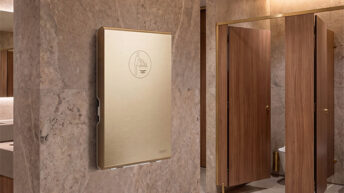
Babymedi: the complete baby changing station
Design, hygiene and certified quality: three essential requirements that a good baby changing station must meet, all brought together in Mediclinics’ Babymedi range. Refined lines and finishes that enhance any project, the dual protection of BioCote® and Ion Hygienic®, and safety backed by international standards and certifications.
Discover the full range of Babymedi baby changing stations and choose the model that best suits your project. A changing station that protects babies while adding an extra touch of design and quality to public restrooms.